2016 is a year where companies need to focus even harder on their search engine optimization efforts than every before to ensure that they exceed their clients expectations and dominate their industry in a competitive online environment.
You need to remember that all your competitors have the same idea you have and they are working hard to push their company up the rankings to that first page, where they increase their chances of being noticed by one of their clients and increase their chances of making a sale, boosting their branding and achieving success moving forward.
With this in mind, you need to know the trends for 2016 in terms of SEO and what you can do to improve your visibility, reach a wider audience and achieve online success. For many companies this starts with hiring a reputable internet marketing company who can assist them in achieving their success, working alongside them daily to boost their visibility and take their SEO efforts and run with them, ensuring that everything is done by the book to make them more visible to Google, their clients and other search engines on a daily basis.
The first trend you will notice in 2016 is that companies are now focusing on more than only Google when it comes to SEO. Google is a major player with most people relying on their search engine to find products or services online, so they should still remain your leading focus, but there is also Yahoo, Bing and other search engines you can focus on, ensuring you tick all the boxes in terms of search engine optimization for all of them, so you can enjoy good results across the board moving forward.
Another focus that is a 2016 SEO trend is social media searches. Unlike previous years finding products and services via social media is growing daily. The younger generation are relying on recommendations from family and friends and use social media more than others. What this means is you need an effective social media campaign in order to achieve results online and this is probably one of the most important aspects of your social media campaign this year.
Then you will find that 2016 is not all technical. Up to now search engine optimization has been about the technical side of things; keyword research, customer analysis and website analysis for example. You will find that 2016 is all about the content. Google wants to make their users have the best search experience, which means they are focusing on content. 2016 will see the quality of content playing a much higher role in search engine optimization, so ensure that you have superior quality content that is informative and interesting and attracts clients to your website daily.
Local optimization is another 2016 SEO trend that is going to take centre stage this year. Since Google introduced their Local SEO algorithm, companies are rallying to ensure that they tick all the boxes required by this top search engine. This means focusing on adding locations to your long tailed keywords and ensuring your company name and address appears on every web page, not only on your contacts page. In order to make head way with local SEO remember to register with as many online directories as possible and start a Google + account to achieve success.
Finally, you will find that the final SEO trend for 2016 is aimed at the mobile user and no surprise there. More people are relying on their mobile devices than every before and for companies to succeed online you have to take these users into consideration. Google is rewarding companies that take the initiative and create a mobile friendly website moving forward.
Article Source: http://EzineArticles.com/9345783
Wednesday, June 15, 2016
Thursday, May 5, 2016
10 Free Online Marketing Tools Every Small Business Owner Needs
Every small business owner needs tools to get their marketing campaigns off the ground. Frankly, too many of these tools are only for enterprise-level businesses or require a budget that doesn't always justify the ROI.
A personal hobby of mine is testing out tools and finding the best ones for myself and the team to use on our campaigns.
After much testing, here are some of my favorites that every small business should have in their tool box. [Editor's Note: Each of the tools listed here has a free version.]
1. Answer The Public
Answer The Public's tool is completely free and has become an integral part of our content strategy. We use it to determine the topics and questions surrounding the primary keywords that we want to rank for. We then try to answer as many of these questions as we can with our content. This way, when Google is looking at which websites have the best information regarding the topic, we're not only more likely to rank, but we also are more likely to convert visitors because we answer the most important questions they have.
2. Open Site Explorer
Understanding your link profile and that of your competitors is crucial to building your Domain Authority. One of the quickest wins in every SEO campaign is to copy and paste your competitor's URL into OSE and find all the sites that are linking to them but not linking to you.
3. Screaming Frog
Screaming Frog is the go-to crawl tool for most everyone in the industry. While they do have a paid version of the tool, you can crawl up to 500 pages for free, leaving most small businesses in the clear. As mentioned above, this tool is terrific for finding broken links, auditing your redirects, finding pages that are missing meta data, and finding duplicate content at a URL level.
4. Siteliner
Siteliner is a dream come true for quick and dirty duplicate content analysis. Once again, they limit the amount of pages you can crawl, but 99% of small businesses are totally fine with the free version. Simply place your url into their search bar and press go. You'll be rewarded with tons of actionable data, like:
5. Portent's Title Generator
Say goodbye to writer's block with this handy tool. Our content team loves to use this tool to come up with highly shareable content ideas. With the simple press of a button, this free tool gives you title ideas that range from serious to downright hilarious. Nobody's ever said: "WOW, that sounds like a boring article; I'll read it!" Have some fun with it, and even if you can't find the perfect title, you're bound to get the creative juices flowing.
6. Google Keyword Planner
Google's keyword tool is a great resource for any small business looking to launch a pay-per-click campaign. Countless opportunities exist to use this tool when setting up an Adwords campaign. One of our favorite features is the search volume calculator. Here, you can enter a keyword and see how many people searched for it each month for the past year. From there, you can layer it with location targeting to get an estimate of how many monthly impressions you'll get for that keyword in your area. On top of search volume metrics, you can check out competition level and suggested bid for any keywords that you select.
7. Moz Local: Check Listing
The key issue for every small business that does business locally and wants to show up in search engines is the consistency of their name, address, and phone number (NAP) across citation sources like Google, Yelp, Facebook, Yellowpages, and more. Moz Local's tool gives you a free way to audit your NAP and easily fix on your own. Or, you can pay to have them do it for you. Either way, it's a great free tool for quick analysis and improvement.
8. Keyword.io
Keyword research is a necessary aspect for every small business' SEO campaign. With this handy tool, you can get keyword ideas from Google to Fiverr to help you understand which keywords to target and/or topics to create content around. Unfortunately, at the free level you're not able to get important metrics like keyword competitiveness or search volume.
If you do have a couple extra bucks to shell out, Moz Pro has done great work with their keyword tool, and recently launched an improved version with some free access. There's also the old-school favorite, Long Tail Pro, which will integrate with Moz and Adwords to give you killer data at scale.
9. Facebook Audience Insights
Facebook Audience Insights is a terrific free tool for doing market and content research. By toggling through the options, you can view specific demographic information about your audience and even learn a few new things.
One great way to use this tool? Allow it to help you create content your audience will love. For example, if you're a local business you can type in your service area/location, toggle the advanced option (bottom of the left column), select "home," and start learning exactly what the homeowners in your area are interested in.
10. Pablo by Buffer
With Buffer's free social media tool, you have access to over 600,000 images (or you can upload your own image) and all the tools necessary to be a social image pro. You start by selecting an image, and from there you are able to overlay with text, choose sizes, select filters, add logos, and download/share. In moments, Pablo makes it easy to go from Photoshop noob to social media design pro.
Bonus: Followerwonk
5728df0184b254.11564901.png
Followerwonk is amazing for quickly and easily analyzing your Twitter followers for information that can be used for your brand. It allows you to search Twitter bios, compare accounts for overlap, drill down by location, see who others are following, and identify influencers. It's a tool with many uses, capable of taking some of the pain out of finding the people who could most help your brand.
Whether you run a small business or market to them, these free tools can help add expertise and insight into your marketing campaigns. Have fun trying them out and feel free to add your favorites in the comments below!
About gmehrguth — Runs an integrated search agency, Directive Consulting, and loves to create content for the industry. Find me on Twitter to keep up with my latest content.
A personal hobby of mine is testing out tools and finding the best ones for myself and the team to use on our campaigns.
After much testing, here are some of my favorites that every small business should have in their tool box. [Editor's Note: Each of the tools listed here has a free version.]
1. Answer The Public
Answer The Public's tool is completely free and has become an integral part of our content strategy. We use it to determine the topics and questions surrounding the primary keywords that we want to rank for. We then try to answer as many of these questions as we can with our content. This way, when Google is looking at which websites have the best information regarding the topic, we're not only more likely to rank, but we also are more likely to convert visitors because we answer the most important questions they have.
2. Open Site Explorer
Understanding your link profile and that of your competitors is crucial to building your Domain Authority. One of the quickest wins in every SEO campaign is to copy and paste your competitor's URL into OSE and find all the sites that are linking to them but not linking to you.
3. Screaming Frog
Screaming Frog is the go-to crawl tool for most everyone in the industry. While they do have a paid version of the tool, you can crawl up to 500 pages for free, leaving most small businesses in the clear. As mentioned above, this tool is terrific for finding broken links, auditing your redirects, finding pages that are missing meta data, and finding duplicate content at a URL level.
4. Siteliner
Siteliner is a dream come true for quick and dirty duplicate content analysis. Once again, they limit the amount of pages you can crawl, but 99% of small businesses are totally fine with the free version. Simply place your url into their search bar and press go. You'll be rewarded with tons of actionable data, like:
- Duplicate content
- Common content
- Unique content
- Average page size
- Average page load time
- Number of words per page
- Internal links
- External links
- Text-to-HTML ratio
5. Portent's Title Generator
Say goodbye to writer's block with this handy tool. Our content team loves to use this tool to come up with highly shareable content ideas. With the simple press of a button, this free tool gives you title ideas that range from serious to downright hilarious. Nobody's ever said: "WOW, that sounds like a boring article; I'll read it!" Have some fun with it, and even if you can't find the perfect title, you're bound to get the creative juices flowing.
6. Google Keyword Planner
Google's keyword tool is a great resource for any small business looking to launch a pay-per-click campaign. Countless opportunities exist to use this tool when setting up an Adwords campaign. One of our favorite features is the search volume calculator. Here, you can enter a keyword and see how many people searched for it each month for the past year. From there, you can layer it with location targeting to get an estimate of how many monthly impressions you'll get for that keyword in your area. On top of search volume metrics, you can check out competition level and suggested bid for any keywords that you select.
7. Moz Local: Check Listing
The key issue for every small business that does business locally and wants to show up in search engines is the consistency of their name, address, and phone number (NAP) across citation sources like Google, Yelp, Facebook, Yellowpages, and more. Moz Local's tool gives you a free way to audit your NAP and easily fix on your own. Or, you can pay to have them do it for you. Either way, it's a great free tool for quick analysis and improvement.
8. Keyword.io
Keyword research is a necessary aspect for every small business' SEO campaign. With this handy tool, you can get keyword ideas from Google to Fiverr to help you understand which keywords to target and/or topics to create content around. Unfortunately, at the free level you're not able to get important metrics like keyword competitiveness or search volume.
If you do have a couple extra bucks to shell out, Moz Pro has done great work with their keyword tool, and recently launched an improved version with some free access. There's also the old-school favorite, Long Tail Pro, which will integrate with Moz and Adwords to give you killer data at scale.
9. Facebook Audience Insights
Facebook Audience Insights is a terrific free tool for doing market and content research. By toggling through the options, you can view specific demographic information about your audience and even learn a few new things.
One great way to use this tool? Allow it to help you create content your audience will love. For example, if you're a local business you can type in your service area/location, toggle the advanced option (bottom of the left column), select "home," and start learning exactly what the homeowners in your area are interested in.
10. Pablo by Buffer
With Buffer's free social media tool, you have access to over 600,000 images (or you can upload your own image) and all the tools necessary to be a social image pro. You start by selecting an image, and from there you are able to overlay with text, choose sizes, select filters, add logos, and download/share. In moments, Pablo makes it easy to go from Photoshop noob to social media design pro.
Bonus: Followerwonk
5728df0184b254.11564901.png
Followerwonk is amazing for quickly and easily analyzing your Twitter followers for information that can be used for your brand. It allows you to search Twitter bios, compare accounts for overlap, drill down by location, see who others are following, and identify influencers. It's a tool with many uses, capable of taking some of the pain out of finding the people who could most help your brand.
Whether you run a small business or market to them, these free tools can help add expertise and insight into your marketing campaigns. Have fun trying them out and feel free to add your favorites in the comments below!
About gmehrguth — Runs an integrated search agency, Directive Consulting, and loves to create content for the industry. Find me on Twitter to keep up with my latest content.

Wednesday, May 4, 2016
Announcing Keyword Explorer: Moz's New Keyword Research Tool by Rand Fishkin
A year ago, in April of 2015, I pitched a project internally at Moz to design and launch a keyword research tool, one of the few areas of SEO we've never comprehensively tried to serve. The pitch took effort and cajoling (the actual, internal pitch deck is available here), but eventually received approval, with one big challenge... We had to do it with a team already dedicated to the maintenance and development of our rankings collections and research tools. This project wouldn't get additional staffing — we had to find a way to build it with only the spare bandwidth of this crew.
Sure, we didn't have the biggest team, or the ability to work on the project free from our other obligations, but we had grit. We had passion. We wanted to prove ourselves to our fellow Mozzers and to our customers. We had pride. And we desperately wanted to build something that wasn't just "good enough," but was truly great. Today, I think we've done that.
Meet our new keyword research tool, Keyword Explorer:

If you want to skip hearing about it and just try it out, head on over. You can run 2 free searches/day without even logging in, another 5 with a free community account, and if you're a Pro subscriber, you've already got access. For those who want to learn more, read on!
The 5 big, unique features of Keyword Explorer
Keyword Explorer (which we've taken to calling "KWE" for short) has lots of unique features, metrics, and functionality, but the biggest ones are pretty obvious and, we believe, highly useful:
KWE takes you all the way through the keyword research process — from discovering keyword ideas to getting metrics to building a list, filtering the keywords on it, and prioritizing which ones to target based on the numbers that matter.
KWE features metrics essential to the SEO process — two you're familiar with — Volume and Difficulty — and three that are less familiar: Opportunity, Importance, and Potential. Opportunity estimates the relative CTR of the organic web results on a SERP. Importance is a metric you can modify to indicate a keyword that's more or less critical to your campaign/project. And Potential is a combination of all the metrics built to help you prioritize a keyword list.
Our volume score is the first volume estimation metric we know of that goes beyond what AdWords reports. We do that using Russ Jones' volume bucket methodology and adding in anonymized clickstream data from ~1 million real searchers in the US. From there, Russ has built a model that predicts the search volume range a keyword is likely to have with ~95% accuracy.
Keyword suggestions inside KWE come from almost all the sources we saw SEOs accessing manually in their research processes — Keyword Planner data, Google Suggest, Related Searches, other keywords that the ranking pages also ranked for, topic-modeling ideas, and keywords found from our clickstream data. All of these are available in KWE's suggestions.
Import and export functionality are strongly supported. If you've already got a list of keywords and just want KWE's metrics, you can easily upload that to us and we'll fetch them for you. If you like the KWE process and metrics, but have more you want to do in Excel, we support easy, powerful, fast exports. KWE is built with power users in mind, so go ahead and take advantage of the tool's functionality however works best with your processes.
These five are only some of the time-saving, value-adding features in the tool, but they are, I think, enough to make it worthwhile to give Keyword Explorer a serious look.
A visual walkthrough
As an experiment, I've created a visual, slide-by-slide walkthrough of the tool. If you'd rather *see* vs. read the details, this format might be for you (Slideshare's embedding is having issues today, but you can find the presentation on their site).
And, for those of you who prefer video, we made a short, 2 minute demo of the tool in that format, too:
Of course, there's a ton of nuance and complexity in a product like this, and given Moz's dedication to transparency, you can find all of that detail in the more thorough explanation below.
Keyword Explorer's metrics
KWE's metrics are among the biggest data-driven advances we've made here at Moz, and a ton of credit for that goes to Dr. Pete Meyers and Mr. Russ Jones. Together, these two have crafted something extraordinary — unique metrics that we've always needed for SEO-based keyword research, but never had before. Those include:
Keyword volume ranges
Nearly every keyword research tool available uses a single source for volume data: Google AdWords' Keyword Planner. We all know from studying it that the number AdWords provides is considerably off from reality, and last year, Moz's Russ Jones was able to quantify those discrepancies in his blog post: Keyword Planner's Dirty Secrets.

Since we know that Google's numbers don't actually have precision, but do indicate a bucket, we realized we could create ranges for volume and be significantly more accurate, more of the time. But, that's not all... We also have access to anonymized clickstream data here at Moz, purchased through a third-party (we do NOT collect or use any of our own user data via, for example, the MozBar), that we were able to employ in our new volume ranges.
Using sampling, trend data, and the number of searchers and searches for a given keyword from the clickstream, combined with AdWords' volume data, we produced a volume range that, in our research, showed ~95% accuracy with the true impression counts Google AdWords would report for a keyword whose ad showed during a full month.

We're pretty excited about this model and the data it produces, but we know it's not perfect yet. As our clickstream data grows, and our algorithm for volume improves, you should see more and more accurate ranges in the tool for a growing number of keywords. Today, we have volume data on ~500mm (half a billion) English-language search queries. But, you'll still see plenty of "no data" volume scores in the tool as we can access considerably more terms and phrases for keyword suggestions (more on suggestion sources below).
NOTE: KWE uses volume data modeled on the quantity of searches in the US for a given term/phrase (global English is usually 1.5-3X those numbers). Thus, while the tool can search any Google domain in any country, the volume numbers will always be for US-volume. In the future, we hope to add volume data for other geos as well.
An upgraded, more accurate Keyword Difficulty score
The old Keyword Difficulty tool was one of Moz's most popular (it's still around for another month or so, but will be retired soon in favor of Keyword Explorer). But, we knew it had a lot of flaws in its scoring system. For Keyword Explorer, we invested a lot of energy in upgrading the model. Dr. Pete, Dr. Matt Peters, myself, and Russ had 50+ reply email threads back and forth analyzing graphs, suggesting tweaks, and tuning the new score. Eventually, we came up with a Keyword Difficulty metric that:
Has far more variation than the old model — you'll see way more scores in the 20s and 30s as well as the 80s and 90s than the prior model, which put almost every keyword between 50–80.
Accounts for pages that haven't yet been assigned a PA score by using the DA of the domain.
Employs a smarter, CTR-curve model to show when weaker pages are ranking higher and a page/site may not need as much link equity to rank.
Adjusts for a few domains (like Blogspot and Wordpress) where DA is extremely high, but PA is often low and the inherited domain authority shouldn't pass on as much weight to difficulty.
Concentrates on however many results appear on page 1, rather than the top 20 results.
This new scoring model matches better with my own intuition, and I think you'll find it vastly more useful than the old model.

As you can see from one of my lists above (for Haiku Deck, whose board I joined this year), the difficulty ranges are considerably higher than in the past, and more representative of how relatively hard it would be to rank in the organic results for each of the queries.
A true Click-Through Rate Opportunity score
When you look at Google's results, it's pretty clear that some keywords are worthy of pursuit in the organic web results, and some are not. To date, no keyword research tool we know of has attempted to accurately quantify that, but it's a huge part of determining the right terms and phrases to target.
Once we had access to clickstream data, we realized we could accurately estimate the percent of clicks on a given search result based on the SERP features that appeared. For example, a classic, "ten-blue-links" style search result had 100% of click traffic going to organic results. Put a block of 4 AdWords ads above it, though, and that dropped by ~15%. Add a knowledge graph to the right-hand side and another ~10% of clicks are drawn away.
It would be crazy to treat the prioritization of keywords with loads of SERP features and little CTR on the organic results the same as a keyword with few SERP features and tons of organic CTR, so we created a metric that accurately estimates Click-Through-Rate (CTR), called "Opportunity."

The search above for "Keanu" has an instant answer, knowledge graph, news results, and images (further down). Hence, its Opportunity Score is a measly 37/100, which means our model estimates ~37% of clicks go to the organic results.

But, this search, for "best free powerpoint software" is one of those rare times Google is showing nothing but the classic 10 blue links. Hence, its Opportunity Score is 100/100.
If you're prioritizing keywords to target, you need this data. Choosing keywords without it is like throwing darts with a blindfold on — someone's gonna get hurt.
Importance scores you can modify
We asked a lot of SEOs about their keyword research process early in the design phases of Keyword Explorer and discovered pretty fast that almost everyone does the same thing. We put keyword suggestions from various sources into Excel, get metrics for all of them, and then assign some type of numeric representation to each keyword based on our intuition about how important it is to this particular campaign, or how well it will convert, or how much we know our client/boss/team desperately wants to rank for it.
That self-created score was then used to help weight the final decision for prioritizing which terms and phrases to target first. It makes sense. You have knowledge about keywords both subjective and objective that should influence the process. But it needs to do so in a consistent, numeric fashion that flows with the weighting of prioritization.
Hence, we've created a toggle-able "Importance" score in Keyword Explorer:

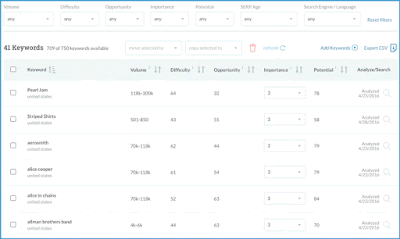
After you add keywords to a list, you'll see the Importance score is, by default, set to 3/10. We chose this number to make it easy to increase a keyword's importance by 3X and easy to bring it down to 1/3rd. As you modify the importance value, overall Keyword Potential (below) will change, and you can re-sort your list based on the inputs you've given.
For example, in my list above, I set "free slideshow software" to 2/10, because I know it won't convert particularly well (the word "free" often does not). But, I also know that churches and religious organizations love Haiku Deck and find it hugely valuable, so I've bumped up the importance of "worship presentation software" to 9/10.
Keyword Potential
In order to prioritize keywords, you need a metric that combines all the others — volume, difficulty, opportunity, and importance — with a consistent, sensible algorithm that lets the best keywords rise to the top. In Keyword Explorer, that metric is "Potential."

Sorting by Potential shows me keywords that have lots of search volume, relatively low difficulty, relatively high CTR opportunity, and uses my custom importance score to push the best keywords to the top. When you build a list in Keyword Explorer, this metric is invaluable for sorting the wheat from the chaff and identifying the terms and phrases with the most promise.
Keyword research & the list building process
Keyword Explorer is built around the idea that, starting from a single keyword search, you can identify suggestions that match your campaign's goals and include them in your list until you've got a robust, comprehensive set of queries to target.
List building is easy — just select the keywords you like from the suggestions page and use the list selector in the top right corner (it scrolls down as you do) to add your chosen keywords to a list, or create a new list:




Sure, we didn't have the biggest team, or the ability to work on the project free from our other obligations, but we had grit. We had passion. We wanted to prove ourselves to our fellow Mozzers and to our customers. We had pride. And we desperately wanted to build something that wasn't just "good enough," but was truly great. Today, I think we've done that.
Meet our new keyword research tool, Keyword Explorer:
If you want to skip hearing about it and just try it out, head on over. You can run 2 free searches/day without even logging in, another 5 with a free community account, and if you're a Pro subscriber, you've already got access. For those who want to learn more, read on!
The 5 big, unique features of Keyword Explorer
Keyword Explorer (which we've taken to calling "KWE" for short) has lots of unique features, metrics, and functionality, but the biggest ones are pretty obvious and, we believe, highly useful:
KWE takes you all the way through the keyword research process — from discovering keyword ideas to getting metrics to building a list, filtering the keywords on it, and prioritizing which ones to target based on the numbers that matter.
KWE features metrics essential to the SEO process — two you're familiar with — Volume and Difficulty — and three that are less familiar: Opportunity, Importance, and Potential. Opportunity estimates the relative CTR of the organic web results on a SERP. Importance is a metric you can modify to indicate a keyword that's more or less critical to your campaign/project. And Potential is a combination of all the metrics built to help you prioritize a keyword list.
Our volume score is the first volume estimation metric we know of that goes beyond what AdWords reports. We do that using Russ Jones' volume bucket methodology and adding in anonymized clickstream data from ~1 million real searchers in the US. From there, Russ has built a model that predicts the search volume range a keyword is likely to have with ~95% accuracy.
Keyword suggestions inside KWE come from almost all the sources we saw SEOs accessing manually in their research processes — Keyword Planner data, Google Suggest, Related Searches, other keywords that the ranking pages also ranked for, topic-modeling ideas, and keywords found from our clickstream data. All of these are available in KWE's suggestions.
Import and export functionality are strongly supported. If you've already got a list of keywords and just want KWE's metrics, you can easily upload that to us and we'll fetch them for you. If you like the KWE process and metrics, but have more you want to do in Excel, we support easy, powerful, fast exports. KWE is built with power users in mind, so go ahead and take advantage of the tool's functionality however works best with your processes.
These five are only some of the time-saving, value-adding features in the tool, but they are, I think, enough to make it worthwhile to give Keyword Explorer a serious look.
A visual walkthrough
As an experiment, I've created a visual, slide-by-slide walkthrough of the tool. If you'd rather *see* vs. read the details, this format might be for you (Slideshare's embedding is having issues today, but you can find the presentation on their site).
And, for those of you who prefer video, we made a short, 2 minute demo of the tool in that format, too:
Of course, there's a ton of nuance and complexity in a product like this, and given Moz's dedication to transparency, you can find all of that detail in the more thorough explanation below.
Keyword Explorer's metrics
KWE's metrics are among the biggest data-driven advances we've made here at Moz, and a ton of credit for that goes to Dr. Pete Meyers and Mr. Russ Jones. Together, these two have crafted something extraordinary — unique metrics that we've always needed for SEO-based keyword research, but never had before. Those include:
Keyword volume ranges
Nearly every keyword research tool available uses a single source for volume data: Google AdWords' Keyword Planner. We all know from studying it that the number AdWords provides is considerably off from reality, and last year, Moz's Russ Jones was able to quantify those discrepancies in his blog post: Keyword Planner's Dirty Secrets.

Since we know that Google's numbers don't actually have precision, but do indicate a bucket, we realized we could create ranges for volume and be significantly more accurate, more of the time. But, that's not all... We also have access to anonymized clickstream data here at Moz, purchased through a third-party (we do NOT collect or use any of our own user data via, for example, the MozBar), that we were able to employ in our new volume ranges.
Using sampling, trend data, and the number of searchers and searches for a given keyword from the clickstream, combined with AdWords' volume data, we produced a volume range that, in our research, showed ~95% accuracy with the true impression counts Google AdWords would report for a keyword whose ad showed during a full month.

We're pretty excited about this model and the data it produces, but we know it's not perfect yet. As our clickstream data grows, and our algorithm for volume improves, you should see more and more accurate ranges in the tool for a growing number of keywords. Today, we have volume data on ~500mm (half a billion) English-language search queries. But, you'll still see plenty of "no data" volume scores in the tool as we can access considerably more terms and phrases for keyword suggestions (more on suggestion sources below).
NOTE: KWE uses volume data modeled on the quantity of searches in the US for a given term/phrase (global English is usually 1.5-3X those numbers). Thus, while the tool can search any Google domain in any country, the volume numbers will always be for US-volume. In the future, we hope to add volume data for other geos as well.
An upgraded, more accurate Keyword Difficulty score
The old Keyword Difficulty tool was one of Moz's most popular (it's still around for another month or so, but will be retired soon in favor of Keyword Explorer). But, we knew it had a lot of flaws in its scoring system. For Keyword Explorer, we invested a lot of energy in upgrading the model. Dr. Pete, Dr. Matt Peters, myself, and Russ had 50+ reply email threads back and forth analyzing graphs, suggesting tweaks, and tuning the new score. Eventually, we came up with a Keyword Difficulty metric that:
Has far more variation than the old model — you'll see way more scores in the 20s and 30s as well as the 80s and 90s than the prior model, which put almost every keyword between 50–80.
Accounts for pages that haven't yet been assigned a PA score by using the DA of the domain.
Employs a smarter, CTR-curve model to show when weaker pages are ranking higher and a page/site may not need as much link equity to rank.
Adjusts for a few domains (like Blogspot and Wordpress) where DA is extremely high, but PA is often low and the inherited domain authority shouldn't pass on as much weight to difficulty.
Concentrates on however many results appear on page 1, rather than the top 20 results.
This new scoring model matches better with my own intuition, and I think you'll find it vastly more useful than the old model.

As you can see from one of my lists above (for Haiku Deck, whose board I joined this year), the difficulty ranges are considerably higher than in the past, and more representative of how relatively hard it would be to rank in the organic results for each of the queries.
A true Click-Through Rate Opportunity score
When you look at Google's results, it's pretty clear that some keywords are worthy of pursuit in the organic web results, and some are not. To date, no keyword research tool we know of has attempted to accurately quantify that, but it's a huge part of determining the right terms and phrases to target.
Once we had access to clickstream data, we realized we could accurately estimate the percent of clicks on a given search result based on the SERP features that appeared. For example, a classic, "ten-blue-links" style search result had 100% of click traffic going to organic results. Put a block of 4 AdWords ads above it, though, and that dropped by ~15%. Add a knowledge graph to the right-hand side and another ~10% of clicks are drawn away.
It would be crazy to treat the prioritization of keywords with loads of SERP features and little CTR on the organic results the same as a keyword with few SERP features and tons of organic CTR, so we created a metric that accurately estimates Click-Through-Rate (CTR), called "Opportunity."

The search above for "Keanu" has an instant answer, knowledge graph, news results, and images (further down). Hence, its Opportunity Score is a measly 37/100, which means our model estimates ~37% of clicks go to the organic results.

But, this search, for "best free powerpoint software" is one of those rare times Google is showing nothing but the classic 10 blue links. Hence, its Opportunity Score is 100/100.
If you're prioritizing keywords to target, you need this data. Choosing keywords without it is like throwing darts with a blindfold on — someone's gonna get hurt.
Importance scores you can modify
We asked a lot of SEOs about their keyword research process early in the design phases of Keyword Explorer and discovered pretty fast that almost everyone does the same thing. We put keyword suggestions from various sources into Excel, get metrics for all of them, and then assign some type of numeric representation to each keyword based on our intuition about how important it is to this particular campaign, or how well it will convert, or how much we know our client/boss/team desperately wants to rank for it.
That self-created score was then used to help weight the final decision for prioritizing which terms and phrases to target first. It makes sense. You have knowledge about keywords both subjective and objective that should influence the process. But it needs to do so in a consistent, numeric fashion that flows with the weighting of prioritization.
Hence, we've created a toggle-able "Importance" score in Keyword Explorer:

After you add keywords to a list, you'll see the Importance score is, by default, set to 3/10. We chose this number to make it easy to increase a keyword's importance by 3X and easy to bring it down to 1/3rd. As you modify the importance value, overall Keyword Potential (below) will change, and you can re-sort your list based on the inputs you've given.
For example, in my list above, I set "free slideshow software" to 2/10, because I know it won't convert particularly well (the word "free" often does not). But, I also know that churches and religious organizations love Haiku Deck and find it hugely valuable, so I've bumped up the importance of "worship presentation software" to 9/10.
Keyword Potential
In order to prioritize keywords, you need a metric that combines all the others — volume, difficulty, opportunity, and importance — with a consistent, sensible algorithm that lets the best keywords rise to the top. In Keyword Explorer, that metric is "Potential."

Sorting by Potential shows me keywords that have lots of search volume, relatively low difficulty, relatively high CTR opportunity, and uses my custom importance score to push the best keywords to the top. When you build a list in Keyword Explorer, this metric is invaluable for sorting the wheat from the chaff and identifying the terms and phrases with the most promise.
Keyword research & the list building process
Keyword Explorer is built around the idea that, starting from a single keyword search, you can identify suggestions that match your campaign's goals and include them in your list until you've got a robust, comprehensive set of queries to target.
List building is easy — just select the keywords you like from the suggestions page and use the list selector in the top right corner (it scrolls down as you do) to add your chosen keywords to a list, or create a new list:

Once you've added keywords to a list, you can go to the lists page to see and compare your sets of keywords:

Each individual list will show you the distribution of metrics and data about the keywords in it via these helpful graphs:

The graphs show distributions of each metric, as well as a chart of SERP features to help illustrate which types of results are most common in the SERPs for the keywords on your list:

For example, you can see in my Rock & Grunge band keywords, there's a lot of news results, videos, tweets, and a few star reviews, but no maps/local results, shopping ads, or sitelinks, which makes sense. Keyword Explorer is using country-level, non-personalized, non-geo-biased results, and so some SERPs won't match perfectly to what you see in your local/logged-in results. In the future, we hope to enable even more granular location-based searches in the tool.
The lists themselves have a huge amount of flexibility. You can sort by any column, add, move, or delete in bulk, filter based on any metric, and export to CSV.

If your list gets stale, and you need to update the metrics and SERP features, it's just a single click to re-gather all the data for every keyword on your list. I was particularly impressed with that feature; to me it's one of the biggest time-savers in the application.
Keyword Explorer's unique database of search terms & phrases
No keyword research tool would be complete without a massive database of search terms and phrases, and Keyword Explorer has just that. We started with a raw index of over 2 billion English keywords, then whittled that down to the ~500 million highest-quality ones (we collapsed lots of odd suggestions we found via iterative crawls of AdWords, autosuggest, related searches, Wikipedia titles, topic modeling extractions, SERPscape — via our acquisition last year — and more) into those we felt relatively confident had real volume).
Keyword Explorer's suggestions corpus features six unique filters to get back ideas. We wanted to include all the types of keyword sources that SEOs normally have to visit many different tools to get, all in one place, to save time and frustration. You can see those filters at the top of the suggestions page:

SERPs Analysis
The final feature of Keyword Explorer I'll cover here (there are lots of cool nooks and crannies I've left for you to find on your own) is the SERPs Analysis. We've broadened the ability of our SERP data to include all the features that often show up in Google's results, so you'll see a page much more representative of what's actually in the keyword SERP:

Holy smack! There's only 3 — yes, THREE — organic results on page one for the query "Disneyland." The rest is sitelinks, tweets, a knowledge graph, news listings, images — it's madness. But, it's also well-represented in our SERPs Analysis. And, as you can see, the Opportunity score of "7" effectively represents just how little room there is for organic CTR.
Over time, we'll be adding and supporting even more features on this page, and trying to grab more of the metrics that matter, too (for example, after Twitter pulled their tweet counts, we had to remove those from the product and are working on a way to get them back).
and more at Moz Blog
Friday, April 8, 2016
New York Search Engine Optimization - Create a Brand Name For Yourself
Creating traffic on the information superhighways! The super speeds of the mechanisms involved in the process of selling products to the customers are seen to be believed. SEO as premier service providers are buzzing with ideas to assist your company in pulling visitors towards the websites. The amount of traffic generated decides the revenue base of a company with the help of a umber of services like SEO consulting, social media optimization, search engine marketing pay per click), behavioral targeting, Web analytics and development. New York search engine optimization as the service providers have growth of your company at their minds and they go to lengths to provide cutting edge techniques to the systems already used. Optimization services in New York ignite the hidden sparks within the business organizations by operating under certain methodologies.
Small is 'big'. So it makes sense to include changes which make a big difference to the sites. The key here, however, is the repeated customer visit which is achieved only by properly studying what works in the first place. New York search engine optimization finds exactly what they are looking for the first time when they visit your website. Internet marketing resources like classifieds, e-marketing, linking, source coding ensure a higher ranking of the websites. This in turn, means a wide customer base which repeatedly visits your site. New York search engine optimization based on an organization's business model and target market choose properly targeted keywords. This ensures hitting it at the right sight with the keywords being tested and optimized repeatedly. The ad campaigns are then created accordingly by the search engine professionals for cost-per-click rates.
Web development and design is next in line. In New York, search engine optimizers utilize a number of applications like Java script, component integration, forums, blogs, online catalogs etc. to make the webpage more accessible amongst the users. The whys and hows of web designing are important processes towards a webpage designing which communicates effectively. Apart from the visual aesthetics of a website, the communication bit must be created and optimized with care. New York search engine optimization as service providers, use information plus persuasion architecture for an effective communication technique which then prompts visitors to take the desired action. It is simple. For instance, if one has to target the customers using a particular cream one can't assume the customers form a particular age group to be contacting them. That would be absurd. An SEO exactly knows that and makes the said site achieve number one ranking having in mind the right techniques for this purpose.
New York search engine optimization puts your business back on the radar of successful growth. In the midst of chatter of various websites, your site is sure to stand out with the assistance of search engine professionals. The SEOs generate traffic with the help of above mentioned visibility techniques. Thus the revenue generated helps the business to survive and maintain a steady posture in the market. Internet is a platform that assists in the growth of a company with a shot in the arm that it badly needs by means of search engine techniques. Decide now and be ahead in the race to reach the top slot online.
Article Source: http://EzineArticles.com/1305216
Small is 'big'. So it makes sense to include changes which make a big difference to the sites. The key here, however, is the repeated customer visit which is achieved only by properly studying what works in the first place. New York search engine optimization finds exactly what they are looking for the first time when they visit your website. Internet marketing resources like classifieds, e-marketing, linking, source coding ensure a higher ranking of the websites. This in turn, means a wide customer base which repeatedly visits your site. New York search engine optimization based on an organization's business model and target market choose properly targeted keywords. This ensures hitting it at the right sight with the keywords being tested and optimized repeatedly. The ad campaigns are then created accordingly by the search engine professionals for cost-per-click rates.
Web development and design is next in line. In New York, search engine optimizers utilize a number of applications like Java script, component integration, forums, blogs, online catalogs etc. to make the webpage more accessible amongst the users. The whys and hows of web designing are important processes towards a webpage designing which communicates effectively. Apart from the visual aesthetics of a website, the communication bit must be created and optimized with care. New York search engine optimization as service providers, use information plus persuasion architecture for an effective communication technique which then prompts visitors to take the desired action. It is simple. For instance, if one has to target the customers using a particular cream one can't assume the customers form a particular age group to be contacting them. That would be absurd. An SEO exactly knows that and makes the said site achieve number one ranking having in mind the right techniques for this purpose.
New York search engine optimization puts your business back on the radar of successful growth. In the midst of chatter of various websites, your site is sure to stand out with the assistance of search engine professionals. The SEOs generate traffic with the help of above mentioned visibility techniques. Thus the revenue generated helps the business to survive and maintain a steady posture in the market. Internet is a platform that assists in the growth of a company with a shot in the arm that it badly needs by means of search engine techniques. Decide now and be ahead in the race to reach the top slot online.
Article Source: http://EzineArticles.com/1305216
Thursday, April 7, 2016
Keyword research: a key element of SEO & Content Marketing
Many business owners see SEO and content marketing as separate, but columnist Trond Lyngbø argues that solid keyword research can and should be used to inform content marketing strategy.
Imagine that you are in an auditorium, facing a large audience of your best customers. You’re getting ready to speak to them.
You can say whatever you want, but there’s just one condition: As soon as you complete your first sentence, people can decide whether to stay inside and listen to the rest of your speech — or get up and leave.
What will you tell them in those crucial first moments?
This is a dilemma every business owner, blogger and content producer agonizes over every day. A visitor to your website decides within a few seconds if she is going to stick around and explore it or leave for another destination.
Unless your content is carefully planned and masterfully crafted based on a deep and intimate understanding of your target audience’s needs, your SEO initiatives will likely fail or underperform. Keyword research and analysis is one of the most critical elements of your content preparation, planning and production.
Key questions to consider here are:
How to tell your story
In one of my most popular posts on content marketing and SEO, I highlight the important element of effective content marketing:
Tell stories that people find interesting.
But how can you know what they will respond to?
You can keep your eyes and ears open and observe what’s happening in your niche — but that takes time, and you’ll only scan a tiny segment of your market.
You can conduct formal surveys of customers and prospects — though there’s always a risk they might mislead you, for various reasons.
Or you can use a very reliable tool: search engines!
People type queries into the search box that are of interest to them. If you can leverage tools like Google Trends, Google Predictive Search, Google Keyword Planner and KeywordTool.io to mine this rich treasure trove of keyword data and identify patterns, you’ll soon have a pretty good idea of what your audience wants.
You can use search engines to find out what worries people, what interests them, which problems they want solved and which desires they dream of having fulfilled.
Know what your people want
Unless you involve keyword research and analysis as a part of your SEO content preparation and planning, you’re spinning your wheels. With strong keyword data, you can communicate better, prioritize your SEO content in accordance with your market’s requirements and engage visitors more deeply to convert them into buyers with less time, effort and expense.
Knowing your customers is the key here. Your keyword research should help illuminate what they want and why they want and need it. From there, you can determine how your product helps them solve their problems and achieve their goals.
This knowledge helps you strategically plan your content marketing and brings several benefits to your business.
1. Better understand your customers
When your content seems to magically answer their unvoiced questions, visitors arriving at your website via search engines will be highly impressed.
Keyword research and analysis helps you to understand your prospective customers. By knowing what search terms they use to find your product or service offerings, you gain insight into their needs and desires — what problems they want solved, what they expect to find on a destination website and so on.
By reviewing the keywords searchers are using — and closely analyzing the search results that surface for those keywords — you can tell, with reasonable accuracy, where a searcher is on the decision-making continuum that ends in closing a sale.
For example, if you run a hotel website, then a visitor arriving at your site from a search on generic or broad terms (like “Norway holiday”) is less likely to book a room than one who is running more specific queries (like “budget hotel in Oslo” or “Oslo hotel vacancy 15th March”).
Thus, if you’re receiving significant traffic from visitors searching on these generic terms, you might want to consider creating and optimizing content that better speaks to their needs and is designed to move them further down the sales funnel.
When your content is designed to match user intent, you will grab attention instantly — and retain it for as long as you meet your visitor’s unspoken needs.
2. Communicate more effectively
Another advantage of keyword research and analysis is that your communication will be more effective, targeted and specific. Your content can be crafted in a manner such that a reader intuitively feels that you are “speaking their language.”
You develop empathy more easily. You connect more deeply. Engage with more sincerity. Convince, educate, inform and guide more meaningfully. And all of this happens because you meet the user where they are at the moment and lead them toward a destination that you know they want to reach.
With keyword research, you can construct content that perfectly targets your message while appealing to visitors who use specific search terms to find you. Each piece of content can be individually designed to speak to a specific, clearly defined segment of your overall market.
When your message is so finely targeted at a particular interest group or niche audience, it becomes very effective at getting prospects to do what you want. Conversion rates are higher. Marketing expenses go down.
3. Plan content more easily
Strong keyword research allows you to correctly prioritize content. It can inform your editorial calendar, as you’ll have a reasonable idea of what content is most in demand and when it is likely to deliver the greatest impact on your business goals.
If you focus on the right keywords and plan accordingly, your content will reach prospective customers right at the moment they are starting to look for it.
4. Go beyond relevant - be memorable
Many SEO and content experts recommend creating “relevant content” for your target keywords. But relevant content is no longer adequate; it isn’t ambitious enough. As search engine algorithms grow more sophisticated and are better able to surface accurate results for a given query, your “relevant” content will just drown in an ocean of other “relevant” pieces.
Instead, you should aim to create amazing content — the kind that makes your website the ultimate destination for your audience. To win at SEO, your content should go above and beyond that of your competitors, anticipating any and all questions a visitor might have (based on the keywords they’re using) and answering those questions fully.
An excellent content strategy will force people to remember you. It is good for branding. Others may even link to your content; if you’re lucky, you’ll receive high-quality backlinks from authority websites in your niche, including newspapers, industry leading sites and thought leaders who will share it on social media. All this improves your SEO and drives more free traffic your way.
5. Combine creativity with data
Many people think working with keyword data cramps creativity in content. It doesn’t have to be an either-or choice. You can be creative while using search data effectively.
The truth is, without data, you run the risk of wasting time and money on content that won’t move you closer to your business goals. Without granular and detailed keyword data, you’re just another person with an opinion, wasting your (or your client’s) money on a risky gamble.
Stop taking chances and secure your business’s future by basing your content marketing on solid search data and knowledge.
Implementing keyword research in your business
Are you beginning to see how great an impact keyword-focused content can have on sales, revenue and profit? If you’ve been ignoring this aspect of SEO for a long time, you are probably damaging your business, limiting its potential and holding yourself back from maximizing revenue.
With the right guidance on keywords and a smart content strategy, you’ll be able to communicate more effectively with customers. When you know your readers’ innermost thoughts and can intuit their intent, it is easy to reverse-engineer this insight so that it is mirrored in your content.
Doing this dramatically improves the level of engagement with your audience. People no longer merely like your content… they love it. They’ll share it with others. And come back for more of it. They’re influenced and informed by it. And this, in turn, improves conversion rates, generating more sales and higher profits.
While content is just a small part of the overall SEO landscape, it’s an important part. Make sure that you get it right!
Source: http://searchengineland.com/keyword-research-key-element-seo-content-marketing-246418
Imagine that you are in an auditorium, facing a large audience of your best customers. You’re getting ready to speak to them.
You can say whatever you want, but there’s just one condition: As soon as you complete your first sentence, people can decide whether to stay inside and listen to the rest of your speech — or get up and leave.
What will you tell them in those crucial first moments?
This is a dilemma every business owner, blogger and content producer agonizes over every day. A visitor to your website decides within a few seconds if she is going to stick around and explore it or leave for another destination.
Unless your content is carefully planned and masterfully crafted based on a deep and intimate understanding of your target audience’s needs, your SEO initiatives will likely fail or underperform. Keyword research and analysis is one of the most critical elements of your content preparation, planning and production.
Key questions to consider here are:
- How do you link SEO and keyword analysis to content marketing?
- How do you produce content that your prospects will find irresistible?
- How can you expand, grow and consolidate your profitability with an intelligent content strategy?
- These are questions we’ll address in this column.
How to tell your story
In one of my most popular posts on content marketing and SEO, I highlight the important element of effective content marketing:
Tell stories that people find interesting.
But how can you know what they will respond to?
You can keep your eyes and ears open and observe what’s happening in your niche — but that takes time, and you’ll only scan a tiny segment of your market.
You can conduct formal surveys of customers and prospects — though there’s always a risk they might mislead you, for various reasons.
Or you can use a very reliable tool: search engines!
People type queries into the search box that are of interest to them. If you can leverage tools like Google Trends, Google Predictive Search, Google Keyword Planner and KeywordTool.io to mine this rich treasure trove of keyword data and identify patterns, you’ll soon have a pretty good idea of what your audience wants.
You can use search engines to find out what worries people, what interests them, which problems they want solved and which desires they dream of having fulfilled.
Know what your people want
Unless you involve keyword research and analysis as a part of your SEO content preparation and planning, you’re spinning your wheels. With strong keyword data, you can communicate better, prioritize your SEO content in accordance with your market’s requirements and engage visitors more deeply to convert them into buyers with less time, effort and expense.
Knowing your customers is the key here. Your keyword research should help illuminate what they want and why they want and need it. From there, you can determine how your product helps them solve their problems and achieve their goals.
This knowledge helps you strategically plan your content marketing and brings several benefits to your business.
1. Better understand your customers
When your content seems to magically answer their unvoiced questions, visitors arriving at your website via search engines will be highly impressed.
Keyword research and analysis helps you to understand your prospective customers. By knowing what search terms they use to find your product or service offerings, you gain insight into their needs and desires — what problems they want solved, what they expect to find on a destination website and so on.
By reviewing the keywords searchers are using — and closely analyzing the search results that surface for those keywords — you can tell, with reasonable accuracy, where a searcher is on the decision-making continuum that ends in closing a sale.
For example, if you run a hotel website, then a visitor arriving at your site from a search on generic or broad terms (like “Norway holiday”) is less likely to book a room than one who is running more specific queries (like “budget hotel in Oslo” or “Oslo hotel vacancy 15th March”).
Thus, if you’re receiving significant traffic from visitors searching on these generic terms, you might want to consider creating and optimizing content that better speaks to their needs and is designed to move them further down the sales funnel.
When your content is designed to match user intent, you will grab attention instantly — and retain it for as long as you meet your visitor’s unspoken needs.
2. Communicate more effectively
Another advantage of keyword research and analysis is that your communication will be more effective, targeted and specific. Your content can be crafted in a manner such that a reader intuitively feels that you are “speaking their language.”
You develop empathy more easily. You connect more deeply. Engage with more sincerity. Convince, educate, inform and guide more meaningfully. And all of this happens because you meet the user where they are at the moment and lead them toward a destination that you know they want to reach.
With keyword research, you can construct content that perfectly targets your message while appealing to visitors who use specific search terms to find you. Each piece of content can be individually designed to speak to a specific, clearly defined segment of your overall market.
When your message is so finely targeted at a particular interest group or niche audience, it becomes very effective at getting prospects to do what you want. Conversion rates are higher. Marketing expenses go down.
3. Plan content more easily
Strong keyword research allows you to correctly prioritize content. It can inform your editorial calendar, as you’ll have a reasonable idea of what content is most in demand and when it is likely to deliver the greatest impact on your business goals.
If you focus on the right keywords and plan accordingly, your content will reach prospective customers right at the moment they are starting to look for it.
4. Go beyond relevant - be memorable
Many SEO and content experts recommend creating “relevant content” for your target keywords. But relevant content is no longer adequate; it isn’t ambitious enough. As search engine algorithms grow more sophisticated and are better able to surface accurate results for a given query, your “relevant” content will just drown in an ocean of other “relevant” pieces.
Instead, you should aim to create amazing content — the kind that makes your website the ultimate destination for your audience. To win at SEO, your content should go above and beyond that of your competitors, anticipating any and all questions a visitor might have (based on the keywords they’re using) and answering those questions fully.
An excellent content strategy will force people to remember you. It is good for branding. Others may even link to your content; if you’re lucky, you’ll receive high-quality backlinks from authority websites in your niche, including newspapers, industry leading sites and thought leaders who will share it on social media. All this improves your SEO and drives more free traffic your way.
5. Combine creativity with data
Many people think working with keyword data cramps creativity in content. It doesn’t have to be an either-or choice. You can be creative while using search data effectively.
The truth is, without data, you run the risk of wasting time and money on content that won’t move you closer to your business goals. Without granular and detailed keyword data, you’re just another person with an opinion, wasting your (or your client’s) money on a risky gamble.
Stop taking chances and secure your business’s future by basing your content marketing on solid search data and knowledge.
Implementing keyword research in your business
Are you beginning to see how great an impact keyword-focused content can have on sales, revenue and profit? If you’ve been ignoring this aspect of SEO for a long time, you are probably damaging your business, limiting its potential and holding yourself back from maximizing revenue.
With the right guidance on keywords and a smart content strategy, you’ll be able to communicate more effectively with customers. When you know your readers’ innermost thoughts and can intuit their intent, it is easy to reverse-engineer this insight so that it is mirrored in your content.
Doing this dramatically improves the level of engagement with your audience. People no longer merely like your content… they love it. They’ll share it with others. And come back for more of it. They’re influenced and informed by it. And this, in turn, improves conversion rates, generating more sales and higher profits.
While content is just a small part of the overall SEO landscape, it’s an important part. Make sure that you get it right!
Source: http://searchengineland.com/keyword-research-key-element-seo-content-marketing-246418
Thursday, February 18, 2016
Google Core Update 2016: Analysis of Winners and Losers
The new year has begun with a confirmed Google update. However, what was initially believed to be either a change to Panda or Penguin is in fact a core ranking algorithm update. Here, we take a look at the fresh data from the Searchmetrics Suite.


Background to Google update
We were expecting a Penguin update for the start of 2016. Initial analyses from the weekend 9/10 January were focused on this. The changes in the Google rankings were considerable on a global scale and various services that measure changes in Google search results came to similar conclusions.
Meanwhile several Google employees have spoken about the update via Twitter: John Mueller and Gary Illyes have confirmed that the observed turbulence is in fact due to a Google update – not the expected Penguin update, but an update to the core ranking algorithm.
Analysis: lots of change, few observable patterns
We have pulled fresh research data from the Searchmetrics Suite to analyze the changes in Google search results. We observed massive changes in the top 100 websites by SEO Visibility (our flagship indicator for online performance) – 50% of the websites that are now amongst the winners and losers are different to before the update. This holds true for both desktop and mobile SERPs. We have tried to detect any patterns that are characteristic of a quality update, which we will now have a closer look at.
Content quality is decisive
We drew attention to the volatility of the search results following last update of 2015 – Phantom III / Quality Update. This volatility matches again with the current data. In particular in the USA publisher websites with pieces of content that rank with brand keywords and entities have witnessed heavy losses in visibility. Brands, on the other hand, have seen a boost in rankings. This trend is not yet noticeable in other international markets, which could indicate that the update has not yet been rolled out globally.
Let’s take a look at the biggest loser in the US – theatlantic.com. This publisher has primarily lost with old URLs that ranked for brand keywords and entities:
It is apparent that many loser domains are classic print publishers and their losses in rankings mainly stem from older content pieces. Additional publisher who lost rankings are newyorker.com, vanityfair.com, arstechnica.com, fastcompany.com and economist.com.
These losses amongst publishers are mainly compensated by corresponding gains amongst brands such as alaskaair.com.
Parallel to this development many publishers have actually won in Google.com search results. Particularly those publishers with current or holistic content. Top winner according to our most recent Suite data is gq.com. On gq.com the biggest winning URL is a comprehensive article about NFL star Tom Brady, shown here in the screenshot on the left.
The article contains photos and a video and a lot of text (more than 3000 words including an interview). A test with Content Optimization in the Searchmetrics Suite shows that the article covers all important subtopics about entity Tom Brady.
Additioanl publishers who gained visibility are time.com, qz.com, howstuffworks.com, politico.com and inquisitr.com.
Whether a publisher or brands won or lost for a specific keyword is dependent on the individual QDF score that Google calculates according to current events and user behavior, particularly search volume. For topics that are current, obviously publishers with current content witnessed visibility gains.
In summary, the quality of the content is absolutely decisive for rankings.
User intent instead of content
One group of winners is particularly suprising for SEOs: educational games. Domains such as brainpop.com and mathplayground.com with landing pages such as this:
The screenshot is no cropped, this is actually the complete page. If you are thinking of cloacking or hidden content, just take a look at the Google cache:
From a classical SEO perspective, these rankings can hardly be explained. There is only one possible explanation: user intent. If someone is searching for “how to write a sentence” and finds a game such as this, then the user intention is fulfilled. Also the type of content (interactive game) has a well above average time-on-site. According to SimilarWeb, the duration of an average visit to BrainPOP is more than 8 minutes, with a bounce rate below 20%.
Even though the site regained rankings, BrainPOP is a good example of the downside of having a lot of pages with low amounts of content: each page only ranks for a few keywords, as our Content Performance analysis shows quite well:
Conclusion: High quality, longform content pieces that cover a topic in-depth are the winners in many areas. But the sheer amount of content is not decisive for rankings, rather the question of whether the content is relevant and fulfils the user intention.
De-indexed guitar tab pages
Websites that offer guitar tabs have been completely de-indexed in some cases. Let’s take a look at the visibility of ultimate-guitar.com as an example:
This change, being de-indexed, has been implemented globally. This has also been carried out for guitartab.com in the US:
Due to the branch specific nature of this complete de-indexation of thousands of URLs, we suspect this change was implemented manually. In addition, ranking positions have been filled by pages with effectively the same content (guitar tabs). The former market leader Ultimate Guitar still ranks for some keywords, however, typically with relatively low quality subpages in correspondingly low ranking positions. The complete domain has not been de-indexed. While the subdomain tabs.ultimate-guitar.com has been completely de-indexed, the editorial content can still be found in the Google index.
As always we will continue to monitor the data and keep you abreast of any further changes. Have you noticed any changes in your rankings or have any more info about the update? – Let us know in the comments below.
Thursday, September 17, 2015
SEO Tutorial - 5 Effective SEO Techniques
SEO tutorial 1 - Keywords
Keywords are best described as words that people type into search engines to find the result they want i.e. 'How to build a blog'. If you are writing say a blog post it is important to enter keywords multiple times within your text. Why? Because the more keywords that are used, the more relevant your website will appear to Google for its searchers. Notice when you type something into Google all the results have your searched words in bold... Keywords. To select your keywords all you basically have to do is create a mind map, write down words that are applicable to your site and relating topics (keep out irrelevant ones like 'and' 'on').
Please note not to overly plaster your text with keywords. If your keywords are occurring too many times Google may see this as spam and actually harm your visibility.
SEO tutorial 2 - Content Creation
If you are running a website and not a blog, it will be useful to add a blog after all. As you write posts about your niche the number of keywords you use on your site increases which can rank you higher on the search engines. More keywords means that your site can be more relevant in the eyes of Google. Not only that, each blog post has its own unique URL so your site will have a larger amount of links that can appear on the search engine.
As well as relevance Google wants to provide its searchers with the best, most up to date content. So if you are regularly updating your website with information i.e. blog posts, you can score some additional SEO points.
SEO tutorial 3 - Back links
A back link is basically a link to your website that appears on another website. This links back to your website hence 'back link'. Back links are important for SEO because if Google can see that you are linking to multiple sites (which it does) it will believe your site as a relevant and higher authority, ranking you higher. You can add back links on posts you provide on other blogs, forums etc.
Beware! Only provide back links to sites that are already popular and rank high on the search engines. If you link to 'crap' sites Google will think yours is crap to.
SEO tutorial 4 - Social media
It is said that implementing social media onto your website helps boost rankings. Visitors can 'like' your website creating more links which will go towards your link building.
If your website has a lot of Followers Google can see you as a high authority website which can also boost your ranking. Ignore buying hundreds of thousands of followers as if there is no consistency in the followers you get, the chances are Google may pick up on this and actually harm your ranking.
SEO tutorial 5 - mobile optimization
This is something new to the SEO tutorials due to the increased use with smart phones. Make sure your website is optimized on mobiles. If your website is properly usable and viable on multiple devices Google can boost the rank of your site compared to others as you can provide a platform others can't.
If you enjoyed reading this SEO tutorial we have some other great articles for you to read
If you would like to learn more about effective SEO, gaining traffic and much more visit our site which contains some fantastic content.
Article Source: http://EzineArticles.com/9139942
Keywords are best described as words that people type into search engines to find the result they want i.e. 'How to build a blog'. If you are writing say a blog post it is important to enter keywords multiple times within your text. Why? Because the more keywords that are used, the more relevant your website will appear to Google for its searchers. Notice when you type something into Google all the results have your searched words in bold... Keywords. To select your keywords all you basically have to do is create a mind map, write down words that are applicable to your site and relating topics (keep out irrelevant ones like 'and' 'on').
Please note not to overly plaster your text with keywords. If your keywords are occurring too many times Google may see this as spam and actually harm your visibility.
SEO tutorial 2 - Content Creation
If you are running a website and not a blog, it will be useful to add a blog after all. As you write posts about your niche the number of keywords you use on your site increases which can rank you higher on the search engines. More keywords means that your site can be more relevant in the eyes of Google. Not only that, each blog post has its own unique URL so your site will have a larger amount of links that can appear on the search engine.
As well as relevance Google wants to provide its searchers with the best, most up to date content. So if you are regularly updating your website with information i.e. blog posts, you can score some additional SEO points.
SEO tutorial 3 - Back links
A back link is basically a link to your website that appears on another website. This links back to your website hence 'back link'. Back links are important for SEO because if Google can see that you are linking to multiple sites (which it does) it will believe your site as a relevant and higher authority, ranking you higher. You can add back links on posts you provide on other blogs, forums etc.
Beware! Only provide back links to sites that are already popular and rank high on the search engines. If you link to 'crap' sites Google will think yours is crap to.
SEO tutorial 4 - Social media
It is said that implementing social media onto your website helps boost rankings. Visitors can 'like' your website creating more links which will go towards your link building.
If your website has a lot of Followers Google can see you as a high authority website which can also boost your ranking. Ignore buying hundreds of thousands of followers as if there is no consistency in the followers you get, the chances are Google may pick up on this and actually harm your ranking.
SEO tutorial 5 - mobile optimization
This is something new to the SEO tutorials due to the increased use with smart phones. Make sure your website is optimized on mobiles. If your website is properly usable and viable on multiple devices Google can boost the rank of your site compared to others as you can provide a platform others can't.
If you enjoyed reading this SEO tutorial we have some other great articles for you to read
If you would like to learn more about effective SEO, gaining traffic and much more visit our site which contains some fantastic content.
Article Source: http://EzineArticles.com/9139942
Tuesday, September 15, 2015
Choosing an SEO Firm to Market Your Website
Search Engine Optimization is not just a luxury anymore. If you want a powerful and effective website that brings traffic and results, SEO is an absolute must. But choosing the right firm can be tricky, especially if you're not familiar with what SEO firms should actually be doing. Here are some tips to help you, as well as some warning signs to watch out for when choosing an SEO firm to market your website.
Pricing
When choosing an SEO firm, you will obviously want to get the best bang for your buck. However, because SEO firms usually offer different pricing for different services and lengths of terms, price shopping can be complicated. Things to look out for:
Length Of Service
Most SEO firms will offer several options for length of service. How long is best? It depends. Generally, a 3 month term is the absolute minimum you need in order to see real results. Most people start out with a 6 month term, as it is long enough to see results but not too long if you aren't happy with your firm. Just remember, if your SEO firm is reputable, the longer your term the better results you will likely see.
Why So Long?
It's important to understand why continued SEO service produces better results. SEO is not like remodeling your kitchen, where you do it once and relax for 20 years; the very nature of SEO requires continual maintenance, monitoring, and tweaking. Search engines report that keyword searches are constantly changing, and their algorithms shift on a daily basis now. Any good SEO firm understands this, and will continually monitor your rankings and work to increase them.
Make Sure They Are Ethical
Like much in this world, there are SEO firms that are above board, and there are those that are not. Obviously, go with the one that uses honest, white-hat methods for optimizing your website. A reputable, ethical SEO firm uses content building, blogs, social media networking and link building as part of their strategy.
Beware Of The Following Red Flags And Avoid These Firms Like The Plague:
NewSunSEO : Internet Marketing NYC
http://NewSunSEO.com
NewSunSEO develops and utilizes search engine optimization strategies that result in top placements. With extensive knowledge about the underlying structure of search engines, we help your website gain exposure, added traffic and more business. NewSunSEO uses the top current technologies with highly effective, ethical methods that are proven to work continually.
Visit our Blog to read, comment, and/or ask questions about Internet Marketing at [http://SEO-Blog.NewSunSEO.com]
Written by Terri Polk at NewSunSEO Inc.
Article Source: http://EzineArticles.com/1450608
Pricing
When choosing an SEO firm, you will obviously want to get the best bang for your buck. However, because SEO firms usually offer different pricing for different services and lengths of terms, price shopping can be complicated. Things to look out for:
- The SEO firm should be clear about all fees and the services included with those fees, upfront.
- Most will require some sort of initial payment, but will usually draw up a payment plan for the remainder of your term; avoid firms that require full payment up front. If you want to pay in full, that's fine, but requiring it should be a red flag.
Length Of Service
Most SEO firms will offer several options for length of service. How long is best? It depends. Generally, a 3 month term is the absolute minimum you need in order to see real results. Most people start out with a 6 month term, as it is long enough to see results but not too long if you aren't happy with your firm. Just remember, if your SEO firm is reputable, the longer your term the better results you will likely see.
Why So Long?
It's important to understand why continued SEO service produces better results. SEO is not like remodeling your kitchen, where you do it once and relax for 20 years; the very nature of SEO requires continual maintenance, monitoring, and tweaking. Search engines report that keyword searches are constantly changing, and their algorithms shift on a daily basis now. Any good SEO firm understands this, and will continually monitor your rankings and work to increase them.
Make Sure They Are Ethical
Like much in this world, there are SEO firms that are above board, and there are those that are not. Obviously, go with the one that uses honest, white-hat methods for optimizing your website. A reputable, ethical SEO firm uses content building, blogs, social media networking and link building as part of their strategy.
- Ethical SEO firms will have no problem giving you references or testimonials from other clients. Impressive results speak for themselves and any good firm will be glad to show off their successes to you.
- A good SEO firm should also provide you with monthly reports showing your site's rankings, stats, and charting its growth.
- The staff at your SEO firm should be willing and available during business hours to answer any questions you may have.
Beware Of The Following Red Flags And Avoid These Firms Like The Plague:
- Never use a firm that practices keyword "stuffing". This unethical practice entails loading a web page with targeted keywords strung together in nonsense paragraphs for the purpose of increasing search engine rankings. However, the search engines got wise to this form of cheating and now give poor rankings to any pages using this technique.
- Avoid firms that claim they have special techniques, or preferred relationships with Google. There is no magic secret to SEO. Continuous maintenance, fresh content, and hard work are what works and any firm claiming otherwise is hiding something.
- No reputable SEO firm can guarantee immediate results, a precise number of visitors, or even a certain ranking within a certain amount of time. These grandiose statements may sound good, but it is impossible to predict exact timeframes or numbers. An honest firm might tell you that they will work until they have achieved a certain goal, but promising to deliver specific results in a slated amount of time should be a warning to you.
NewSunSEO : Internet Marketing NYC
http://NewSunSEO.com
NewSunSEO develops and utilizes search engine optimization strategies that result in top placements. With extensive knowledge about the underlying structure of search engines, we help your website gain exposure, added traffic and more business. NewSunSEO uses the top current technologies with highly effective, ethical methods that are proven to work continually.
Visit our Blog to read, comment, and/or ask questions about Internet Marketing at [http://SEO-Blog.NewSunSEO.com]
Written by Terri Polk at NewSunSEO Inc.
Article Source: http://EzineArticles.com/1450608
Friday, September 11, 2015
The Best 7 SEO Strategies for improve your website ranking in 2015

- Optimize for mobile search
- Focus on a variety of keywords
- Don’t ignore social media
- Ditch complicated UX and URL
- Don’t sweat the small stuff
- Long tail SEO still matters
- Pair up with PR
Thursday, September 10, 2015
Web Development Versus Web Design - Is There Really a Difference?
Technology pundits have constantly argued that the terms web development and web design are interchangeable with one another. I respectfully disagree and argue that though the terms may have been interchangeable in the past; they have long since become two terms completely separate from one another with different goals, standards, and philosophies behind them. Web development can be quickly defined as "a broad term for any activity related to developing a web site for the World Wide Web or an intranet. This can include e-commerce business development, web design, web content development, client-side/server-side scripting, and web server configuration"; whereas a definition of web design can be summed up as "a process of conceptualization, planning, modeling, and execution of electronic media content delivery via Internet in the form of technologies" (definitions courtesy of Wikipedia). We can take note of a couple of things simply from these simplified definitions. The first is that web design falls under the wing of web development and it is easy to see why many think the two are intertwined much like the concept that a square is a rectangle, but a rectangle is not a square. Web design is a part of web development, but not actually an essential part of developing the web.
Web design, more specifically website design, is a process of creatively visualizing and utilizing the tools and applications created by the web development process. Web design takes the development process one step further and often finds itself using these tools for ideas and applications vastly different than what they were intended for. A quick analogy would be that of how the plane engine made for war combat was used as the basis for the car engine we use in our every day lives. Web design has brought us things like the web 2.0 concept of user generated content; some thing that web development tools are capable of, though not intended for it specifically. Content management systems such as the ones talked about earlier provide the framework for social networking websites and blogs. Dynamic web pages which appeal to our aesthetic eye use frameworks set forth by web development tools yet take it one step further by using the tool to create a masterpiece of web design.
With all of America's advances in web development it became easy to separate the two terms from their synonymous relationship; it has become a process of developing technologies and applications for the advancement of the World Wide Web. These technologies of course, can be adapted and used by anything related to the internet (such as websites) but is not merely limited to it. Content management systems (CMS) are one of the many examples of positive strides made in web development. CMS systems allow for easy management of content and data while online and can be used for simple server networking within an office, or as the backbone of an ecommerce website (voting systems in various states use CMS systems to tally and record votes via software). Web development also houses things such as the creation, modification, and innovation of scripting and coding languages. The advent of Actionscript 3.0 and PHP 5.2 can be marked as some of the great achievements of the web; Actionscript 3.0 is part of Adobe Flash CS3; however Adobe created AS 3.0 to make it much more logical for creative web applications. More specifically, web development in NY has been known to constantly utilize the most up to date tools and research to create some of the most innovative web applications.
Fred McCoy is a NY Web Development critic who works for Blue Fountain Media; his articles are on point, descriptive, and insightful.
Article Source: http://EzineArticles.com/1439648
Web design, more specifically website design, is a process of creatively visualizing and utilizing the tools and applications created by the web development process. Web design takes the development process one step further and often finds itself using these tools for ideas and applications vastly different than what they were intended for. A quick analogy would be that of how the plane engine made for war combat was used as the basis for the car engine we use in our every day lives. Web design has brought us things like the web 2.0 concept of user generated content; some thing that web development tools are capable of, though not intended for it specifically. Content management systems such as the ones talked about earlier provide the framework for social networking websites and blogs. Dynamic web pages which appeal to our aesthetic eye use frameworks set forth by web development tools yet take it one step further by using the tool to create a masterpiece of web design.
With all of America's advances in web development it became easy to separate the two terms from their synonymous relationship; it has become a process of developing technologies and applications for the advancement of the World Wide Web. These technologies of course, can be adapted and used by anything related to the internet (such as websites) but is not merely limited to it. Content management systems (CMS) are one of the many examples of positive strides made in web development. CMS systems allow for easy management of content and data while online and can be used for simple server networking within an office, or as the backbone of an ecommerce website (voting systems in various states use CMS systems to tally and record votes via software). Web development also houses things such as the creation, modification, and innovation of scripting and coding languages. The advent of Actionscript 3.0 and PHP 5.2 can be marked as some of the great achievements of the web; Actionscript 3.0 is part of Adobe Flash CS3; however Adobe created AS 3.0 to make it much more logical for creative web applications. More specifically, web development in NY has been known to constantly utilize the most up to date tools and research to create some of the most innovative web applications.
Fred McCoy is a NY Web Development critic who works for Blue Fountain Media; his articles are on point, descriptive, and insightful.
Article Source: http://EzineArticles.com/1439648
Wednesday, September 9, 2015
9 Tips To Choose The Best Website Development Company
Web development firms have a greater role in enhancing the client company's brand name and their reputation online. In short, the success of a brand online often relies on the expertise of web developers. More and more customers are turning in to web to get details regarding the products and services offered by a particular brand. And as the popular say goes, "First impression is the best impression" which means a website should be as catchy and impressive as possible to turn a prospective customer in to a business.
A lot of web design companies are available to create website for your company according to the budget you have. But only a professional web development company can see the bigger picture of their client requirements instead of compromising for their short-term goals. A lot of research must happen before choosing the best website designing and development company. Landing in to the wrong development partner will result in long-term consequences that might be damaging for the reputation of your brand.
Here are a few tips that will help you choose the right website development company.
Are they Receptive?
This is an important aspect in the selection of the right web development firm. You will have to check whether the website design company is serious in handling your queries and returning calls. If they are making delays in replying to your queries prior to establishing a contract with them, then it is desirable for you to avoid them since their responsiveness in the long-term once the site launches cannot be guaranteed at all.
Do they have an advisor to brief you?
Companies offering best web development services will have advisors who will try to understand your requirements and will advise you whether you will have to make any changes in the designing and functionality of the website that you have in mind. Usually if the designing of the website does not match with the services you offer, it might turn out to be a waste of money. An advisor can help you clear this obstacle before the start of the web development process itself.
Take a look at the web development firm's own website
Most web design companies showcase their own website to draw clients towards them. If their website is not attractive, then how can they make your website attractive?
Does the web development company provide you with repeated suggestions?
These are strong signs of a genuine website development services company. They often serve you as a trusted guide by claiming that some of your ideas are bad and will have the explanations for it too. It is not necessary for most of the brands approaching website design companies to have a thorough knowledge regarding the changes happening across web standards, eCommerce and security standards, web standards and usability experiences.
Have a look at the previous completed projects
It is essential for the client companies to take a look at the previous projects done by the web development firm they are approaching and prefer to speak with those clients to get a feedback about the web development company.
How after sales service are managed?
This is one area where most of the companies feel disappointed at times with their client web development company. The reason, the lack of enthusiasm to help the brand company once the project is over. The best web development company would engage in a long-term relationship with the client by offering uninterrupted round the clock services to them regarding website maintenance.
Whether direct communication is allowed with the web developers?
More than a marketing person, it is the technical person that will be of use during the development stage of your website. Usually a team of web designers and web developers would be involved in the developmental stages of your website and it is only them who will be able to best understand your requirements when it comes to the creative as well as technical thoughts.
Do you or the web development company own the website code?
Most of the website development companies own the website code since they expect the client to approach them in future also if any changes have to be made. But check whether your company will be comfortable with such restrictions. The client website development company can make the changes easily since they have hands-on experience creating your website where as if you own the website code, you will have the freedom to make any changes. But the task would be a bit difficult for the IT department since the code is developed by the client web development company.
Are comprehensive services offered?
The best web development company would offer comprehensive services and thereby takes the entire responsibility of your website design, development and maintenance. The process starts from developing an initial strategy, planning, design, development, testing as well as marketing.
It has to be taken note that most of these firms are also offering mobile application development. Most of the client companies are moving towards developing a mobile application for their products and services in addition to the website development services since a majority of the customers now uses smartphone for online purchases.
William Hills is a professional and expert content writer. He writes blogs and a variety of quality articles. If you are looking for the best web design company in Washington dc, you can contact JanbaskDigitalDesign. The experienced web designers there satisfy their clients through their amazing work.
Article Source: http://EzineArticles.com/9000728
A lot of web design companies are available to create website for your company according to the budget you have. But only a professional web development company can see the bigger picture of their client requirements instead of compromising for their short-term goals. A lot of research must happen before choosing the best website designing and development company. Landing in to the wrong development partner will result in long-term consequences that might be damaging for the reputation of your brand.
Here are a few tips that will help you choose the right website development company.
Are they Receptive?
This is an important aspect in the selection of the right web development firm. You will have to check whether the website design company is serious in handling your queries and returning calls. If they are making delays in replying to your queries prior to establishing a contract with them, then it is desirable for you to avoid them since their responsiveness in the long-term once the site launches cannot be guaranteed at all.
Do they have an advisor to brief you?
Companies offering best web development services will have advisors who will try to understand your requirements and will advise you whether you will have to make any changes in the designing and functionality of the website that you have in mind. Usually if the designing of the website does not match with the services you offer, it might turn out to be a waste of money. An advisor can help you clear this obstacle before the start of the web development process itself.
Take a look at the web development firm's own website
Most web design companies showcase their own website to draw clients towards them. If their website is not attractive, then how can they make your website attractive?
Does the web development company provide you with repeated suggestions?
These are strong signs of a genuine website development services company. They often serve you as a trusted guide by claiming that some of your ideas are bad and will have the explanations for it too. It is not necessary for most of the brands approaching website design companies to have a thorough knowledge regarding the changes happening across web standards, eCommerce and security standards, web standards and usability experiences.
Have a look at the previous completed projects
It is essential for the client companies to take a look at the previous projects done by the web development firm they are approaching and prefer to speak with those clients to get a feedback about the web development company.
How after sales service are managed?
This is one area where most of the companies feel disappointed at times with their client web development company. The reason, the lack of enthusiasm to help the brand company once the project is over. The best web development company would engage in a long-term relationship with the client by offering uninterrupted round the clock services to them regarding website maintenance.
Whether direct communication is allowed with the web developers?
More than a marketing person, it is the technical person that will be of use during the development stage of your website. Usually a team of web designers and web developers would be involved in the developmental stages of your website and it is only them who will be able to best understand your requirements when it comes to the creative as well as technical thoughts.
Do you or the web development company own the website code?
Most of the website development companies own the website code since they expect the client to approach them in future also if any changes have to be made. But check whether your company will be comfortable with such restrictions. The client website development company can make the changes easily since they have hands-on experience creating your website where as if you own the website code, you will have the freedom to make any changes. But the task would be a bit difficult for the IT department since the code is developed by the client web development company.
Are comprehensive services offered?
The best web development company would offer comprehensive services and thereby takes the entire responsibility of your website design, development and maintenance. The process starts from developing an initial strategy, planning, design, development, testing as well as marketing.
It has to be taken note that most of these firms are also offering mobile application development. Most of the client companies are moving towards developing a mobile application for their products and services in addition to the website development services since a majority of the customers now uses smartphone for online purchases.
William Hills is a professional and expert content writer. He writes blogs and a variety of quality articles. If you are looking for the best web design company in Washington dc, you can contact JanbaskDigitalDesign. The experienced web designers there satisfy their clients through their amazing work.
Article Source: http://EzineArticles.com/9000728
Thursday, April 16, 2015
Top SEO Trends| Need Consider in 2015
1. Content is King:
Google’s latest search engine algorithms focuses more and more on content, which means there is less focus on keyword saturation and more focus on whether or not the content is actually relevant to the keywords.
2. Social Signals Will Be Even More Important

3. Mobile-Friendly SEO will grow

4. Online Security Will Become More Important in Rankings

5. Increased focus on conversations instead of keywords

6. Link Building Will Focus on Brand Mentions

Wednesday, April 15, 2015
Free Shopify Theme Download
Oak Ecommerce Website Template – Free React Online Store Theme
This theme will give your store a rustic yet trendy appearance Great for Food and Drink businesses looking for a great shopify theme.

Lookbook
Responsive, Full-Screen Shopify Theme
Simple (Beauty)
Shopify Theme for Beauty & Fashion Sites
Minimal (Jewelry)
Responsive Textural Theme for Shopify
Subscribe to:
Posts (Atom)